All your Search End Here: Other Sports
Showing posts with label Other Sports. Show all posts

Sunday, 6 November 2011

Court Vision pulls huge upset in the Turf

LOUISVILLE, Ky. (AP)—Court Vision pulled off a 64-1 upset in the $2 million Breeders’ Cup Mile as three-time champion Goldikova finished third in her final race.

Court Vision nipped Turallure by a nose on Saturday at Churchill Downs.

Goldikova, the champion mare from France, failed in her quest for an unprecedented fourth straight Breeders’ Cup win. She battled her way to a brief lead in deep stretch but could not hold off the pair of late challengers.
Goldikova held third, as a claim of foul by Patrick Valenzuela aboard Courageous Cat was disallowed.

Court Vision paid $131.60, the second highest payoff in the world championships after the $269.20 Arcangues paid in the 1993 Classic.

Robby Albarado was aboard for trainer Dale Romans as Court Vision ran the one mile on the turf in 1:37.05.

Tuesday, 1 November 2011

France-trained Dunaden wins Melbourne Cup

 Jockry Christophe Lemaire (R) Of France And Trainer Mikel Delzangles (L) Celebrate


MELBOURNE, Australia (AP)—French-trained Dunaden won the $6.2 million Melbourne Cup on Tuesday, beating England’s Red Cadeaux by a nose in one of the closest finishes in the 151-year history of the two-mile turf handicap.
French jockey Christophe Lemaire guided Dunaden to the front a few strides from the line to hold off the fast-finishing Red Cadeaux, ridden by Australia’s Michael Rodd.
German import Lucas Cranach, owned and trained in Australia, finished third at Flemington, where more than 100,000 fans awaited the photo finish results.
Dunaden, by the British sire Nicobar from the French mare La Marlia, started an 8-1 second favorite after winning the Geelong Cup on Oct. 19 in its first start in Australia. Red Cadeaux started at odds of more than 30-1.
“I’m still shaking. It’s amazing. I thought I was beaten, so it’s even better,” trainer Mikel Delzangles said.
Lemaire arrived in Australia from Japan only 24 hours before the race and was overcome with emotion when his narrow victory was confirmed.
“It’s incredible—it’s a great moment for me,” Lemaire said. “I was a bit anxious. I knew it was very close.
“I feel very sorry for Craig. He’s a good friend of mine. I know it’s very hard for him but it’s part of a jockey’s life and I’m sure he’ll win the Melbourne Cup one year.”
The win was Dunaden’s eighth in 28 starts and earned his owner $3.6 million plus a trophy worth $175,000.

Sunday, 30 October 2011

Sebastian Vettel wins inaugural Indian Grand Prix

 
 Greater Noida - World champion Sebastian Vettel made history by winning India's first ever Formula One with ease on Sunday as McLaren's Jenson Button tightened his grip on the championship's second place.

Red Bull's Vettel led throughout for his 11th victory of the season, finishing some 8.4 seconds ahead of Button with Ferrari's Fernando Alonso third and Australian Mark Webber fourth.

Seven-time champion Michael Schumacher battled to fifth but McLaren's Lewis Hamilton came in seventh after yet another collision with his Ferrari bete noire, Felipe Massa. "My pace was good up until the crash. After the crash, we struggled," said the 2008 champion.
But wire-to-wire Vettel was in a class of his own at the all-new Buddh International Circuit near New Delhi as he closed on Michael Schumacher's 2004 record of 13 wins in one year, with two races left this season.

"Yes boys! Yes, we did it," Vettel shouted over the team radio as he finished. "The first Indian Grand Prix. Fantastic challenge, we did it!"
In dry, 30 Celsius (86 Fahrenheit) heat, India's debut grand prix got off to a furious start when Rubens Barrichello was hit on the first turn and three cars ended up off-track, before Jarno Trulli found himself on grass.

Vettel made no mistake from pole position but Button nipped past Webber and Alonso to go from fourth on the grid to second, cueing up an early dogfight with the Australian Red Bull driver.
As they dueled, Vettel opened up a lead of nearly five seconds and after the first set of stops, the young German emerged from the pit lane still at the head of the field.

Williams' Pastor Maldonado was the first retirement with a gearbox problem and Sebastian Buemi had to stop his Toro Rosso when it started pouring smoke.
And there were fireworks on lap 24 when Hamilton, trapped on the inside by Massa as they hared towards a left-hand turn, shunted the Ferrari driver across the track in the latest of a series of collisions between the two.

Massa was given a drive-through penalty and Hamilton pitted for a new front wing, but the Brazilian's race soon ended in farce as a kerb shattered his front suspension - a replay of the mishap he suffered in qualifying.
Button threatened to close the gap on Vettel in the final laps but there was no catching Formula One's youngest ever back-to-back champion and he punched the air as he took the chequered flag in front of the giant grandstand.

The race's build-up has been overshadowed by two deaths in motorsports this month and the controversial spectacle of glamorous Formula One appearing in one of India's poorest regions.
But its private-sector organisers are already celebrating a smooth and successful event which has helped bury memories of last year's Commonwealth Games, which are remembered for their poor organisation and corruption.

Wednesday, 26 October 2011

Roush, Bayne try to negotiate through ‘team orders’ wreckage

Roush, Bayne try to negotiate through ‘team orders’ wreckage


Heart or head. Dreams or reality. Pleasure or business. When you've got to choose between them with a moment's notice, you may end up in the right place without much liking how you got there. Such was the dilemma of Trevor Bayne at Talladega.
The Bayne/Jeff Gordon "team orders" story isn't going away, and it's not going away because some of the key players continue to make statements that fly directly in the face of their actions on Sunday night.
Step back and put yourself in Bayne's shoes for a moment. You've won the Daytona 500, yes, but you're still very much a rookie. And in one of the biggest races of the year, your idol, a guy you've worshiped for most of your life, comes over your radio and says he wants to pair up with you. This is one of those moments you've dreamed of for your entire life. Are you really going to have the presence of mind to say no?
Well, as it turns out, he should have, because Bayne's initial agreement to run with Jeff Gordon was what kicked off the entire "team orders" fiasco at Talladega, one that's no more clear on Tuesday after statements made by both Bayne and team owner Jack Roush. (While Bayne was technically running for the Wood Brothers, he's part of the Roush Fenway team.)

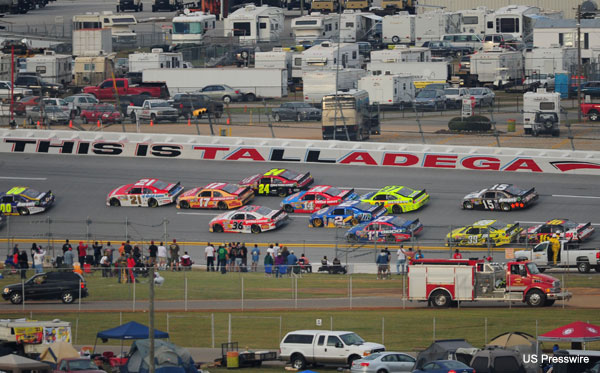
As Gordon recounted Sunday night, in the closing laps of the race Bayne agreed to run with him and the two began talking strategy. But then Bayne left Gordon hanging; Gordon didn't know it, but the No. 6 Ford of David Ragan had blown up, and Bayne dropped back to help Ford/Roush teammate Matt Kenseth. (In the photo above, you can see Bayne in the 21 getting pushed by Kenseth in the 17; Gordon, all alone, is falling backward, where he'd finish 27th.)
Let's get one element out of the way right now, though: Bayne did not reel in Gordon with the express intent of ditching him once the green flag dropped. That's not in Bayne's character, and that's not ethical racing. Despite what some Gordon fans may believe, there's no way Bayne deliberately duped Gordon before the final green.
Ah, but WHY did Bayne drop back? That's starting to become the key question. "This weekend, there were no team orders, from myself or anyone at Roush Fenway, given to any of our drivers as to whom they could or could not choose to run with or assist, nor did I give similar directions or suggestion to any of the other Ford drivers," Roush said in a statement on Tuesday. And in an interview with ESPN's David Newton, Bayne said that he dropped back to help Kenseth on his own volition, not from orders over the radio.
Trouble is, those two accounts don't square with three in-the-moment recollections: Gordon's, Bayne's, and Roush-Fenway's:
• Immediately after the race, Gordon told Yahoo! Sports that Bayne apologized to him in person, right behind the 24's hauler, and said, "It wasn't me, it wasn't me. That's what I'm being told to do."
• Bayne took to Twitter and said he was "strong-armed into bailing" on Gordon.

• And a Roush-Fenway source told Yahoo! Sports on Sunday night that, in fact, there were explicit instructions to help other Ford Chase competitors if necessary. (There were no specific orders not to work with other manufacturers, the source said.)
The purpose of this is not to play "gotcha" here, although the story of who said what to whom at what time has changed in the last 48 hours. It's simply this: be straight-up. Bayne had every right to drop Gordon, and realistically, he had every obligation to help his teammate in a situation like this. Sure, he could have apologized to Gordon over the radio, but this was the middle of a race. Gordon, once he calmed down, was reportedly square with Bayne, who's taking this all much harder than he needs to.
And the idea of there being no team orders given is, quite simply, ludicrous on its face. Talladega and Daytona provide the starkest example of teammates working together; it's obvious that drivers from one team or manufacturer are going to do everything they can to line up with their comrades-in-arms, and that team owners are going to do everything they can to encourage that kind of assistance. To indicate otherwise insults the intelligence of the fans ... or feeds the constant, rampant conspiracy theories, which is even worse.

Wednesday, 19 October 2011

Money title missing piece for player of the year


The PGA Tour money title is relevant for the first time since 2003 because it has come down to two players—Webb Simpson and Luke Donald—in the final tournament of the year at Disney.
But it’s not just about the money.
Simpson had more than just the money title on his mind when he decided to play the McGladrey Classic last week at Sea Island, where missing a 3-foot par putt with his belly putter and losing in a playoff was easy to stomach. The runner-up finish was worth $432,000, and it gave him a $363,029 lead on the money list.
He has two wins this year, as much as anyone else, but no more than five other players. Simpson didn’t win a major, although neither did any of the other player of the year candidates except for Keegan Bradley.
“I still need to do a little something more to get player of the year,” Simpson said at the start of last week. “So I think if I could somehow squeak it out and win the money list, that would just help.”
In a year in which no one has really stood out, it might be just enough.
The PGA Tour player of the year is a vote of the players. The Players Advisory Council nominates the candidates—it could be one of the longer lists — and the ballots will be mailed Oct. 25.
Winning the Arnold Palmer Award for leading the PGA Tour money list might mean even more to Donald. He has a chance to become the first player to win the money titles on the PGA Tour and European Tour in the same season. Donald has a comfortable lead in Europe. His prospects suddenly look bleak in America.
Donald also needs to win the money list to bolster his credential as the player of the year.
He has been ranked No. 1 the last five months, and he is there for a reason. No one has played better golf this year. In 23 tournaments, Donald has won three times, had 17 finishes in the top 10 and finished in the top five in nearly half his tournaments.
Trouble is, he has only one win on the PGA Tour. That was at the Match Play Championship in Arizona, with a performance so resounding that Donald never played the 18th hole at Dove Mountain except in a practice round.
Yes, he added Disney to his schedule at the last minute to try to win the money title. But the bigger picture for Donald is to show his peers how badly he wants to be player of the year. Donald most likely will have to win Disney to capture the money list, and that also would give him two PGA Tour wins—same as Simpson, Bradley, Steve Stricker, Nick Watney,Bubba Watson and Mark Wilson.
The feeling in August was that the FedEx Cup playoffs would go a long way toward determining the PGA Tour player of the year.
Who would have guessed it would be settled in the Fall Series?
Simpson and Donald have emerged as the favorites, so closely linked that if Donald were to win at Disney and Simpson finished second, they would be tied for the points-based player of the year award from the PGA of America.
But it’s not that simple.
There still figures to be sentiment for Bradley, the 25-year-old rookie whose two wins include the PGA Championship. Majors tend to be the tiebreaker in these votes, as David Duval can attest. He won four times in 1998—in the winter, spring, summer and fall—won the money title and the Vardon Trophy for lowest scoring average. He lost the award to Mark O’Meara, who won two majors.
But for a body of work, Bradley has some blemishes.
No one ever voted player of the year has been outside the top 10 on the money list. Bradley is 13th.
Only once in the last 20 seasons has the player of the year missed more than three cuts. That was Nick Price in 1994, who missed the cut five times. He also won six tournaments, including two majors.
Bradley has more missed cuts (10) than top 10s (four).
Bill Haas won the FedEx Cup, but that was based on only one win at the Tour Championship. Watney might get some consideration, with two wins—including a World Golf Championship—along with 10 finishes in the top 10 and finishing third on the money list.
Simpson innocently raised a question last week that players will have to ponder.
“The thing I wish I knew a little better was the definition of player of the year,” Simpson said. “I think most people think it’s like the MVP or basketball or football, but it’s really not.”
His definition?
“It should be the guy who played the best golf during the entire year,” Simpson said. “I think consistency is part of it. I think being in contention and winning tournaments is all in there. I don’t know. I guess it’s up to us players to vote, which I forgot.”
That makes it even more complicated. Players spend all year not paying attention to anyone but themselves.
The four categories that get the most attention are majors, tour victories, money list and lowest adjusted scoring average. Donald appears to have the latter wrapped up at 68.86, with Simpson at 69.23.
The money title was last decided in the final week at the 2003 Tour Championship between Vijay Singh andTiger Woods. Singh had a $768,494 lead and had to finish only in a three-way tie for third. Woods never broke 70 that week, so there wasn’t much drama. Singh won the money title with plenty of room to spare.
Woods won five times that year, compared with Singh’s four wins. Neither won a major. Singh won the money title, Woods the Vardon Trophy. It was said to be a close vote—the tour doesn’t release the results—and Woods won player of the year.
Matt Kuchar won the money title last year by $100,855 over Jim Furyk. Neither played the final event at Disney.
“It would have been a nice feather in the cap,” Furyk said. “But at that point, I had won the Tour Championship, I had a great year, I won three times and the FedEx Cup. And I had an inkling I would win player of the year.”
Ultimately, player of the year is more prestigious than the money list. But in the case of Simpson and Donald, they might not be able to have one without the other.

Tuesday, 11 October 2011

Wrongly convicted Bozella gets a bout at age 52


Walking down the street in Poughkeepsie, N.Y., on an otherwise nondescript summer day in 1977, 18-year-old Dewey Bozella was about to be robbed. What was taken from him was far greater than the value of the personal effects he was carrying.

Bozella was robbed of his freedom, of his chance to have a family, of the opportunity to fulfill a dream. He would be robbed of his life as he knew it.
He was, in his own words “no angel” 34 years ago, but he blanched when he heard the words the police officers who arrested him spoke. Bozella was charged with the murder of 92-year-old Emma Crapser, beginning a decades-long ordeal that resulted in him spending 26 years imprisoned for a crime he did not commit.
“I was not,” he said firmly, “a goodie goodie. No way. I’ll admit that. I had my issues. I was no angel. I got high, did some things on the street I’m not proud of today. But I was no murderer. Murder? No. No way. That made me sick just to hear it.”
As sick as it made him, however, Bozella steadfastly refused to speak the one word that could have gotten him released from prison and allowed him to resume his life: Guilty.
Now 52, Bozella is about to embark on a professional boxing career, fighting a four-round cruiserweight bout against Larry Hopkins on Saturday at Staples Center in Los Angeles on the undercard of the HBO Pay-Per-View show featuring a light heavyweight title fight between Bernard Hopkins and Chad Dawson.
Bozella harbors no illusions of becoming a full-time boxer, though he insists he would have been a world champion had he not spent his prime years at Sing Sing Correctional Facility in Ossining, N.Y. He’s fighting because it’s one of those bucket list things he wanted to do while he is still physically capable.
Bozella was released in the fall of 1977 four months after he was arrested when a grand jury failed to indict him for Crapser’s murder because of a lack of evidence. The only evidence then was the testimony of brothers Lamar and Stanley Smith, who said they saw Bozella and Wayne Moseley break into Crapser’s apartment.
But in April 1983, a second grand jury heard evidence in the case and indicted him on two counts of second-degree murder. The 1983 indictment was secured when the Dutchess County, N.Y., district attorney agreed in writing not to prosecute Wayne Moseley for the murder and to secure Moseley’s release from prison on an unrelated charge in exchange for his testimony against Bozella in the Crapser case.
Bozella was arrested again and, later that year, was convicted. With his immunity deal secure, Moseley testified that he went to Crapser’s home and watched Bozella commit the murder.
There was evidence pointing toward a man named Donald Wise. In 1978, Wise and his brother, Anthony, were convicted of murdering an elderly woman who lived three blocks from where Crapser did. That woman, Estelle Dobler, died when someone shoved cloth down her throat while burglarizing her home.
Another woman in the area, Mary King, was murdered in the same fashion.
Donald Wise’s fingerprint was found on the bathroom mirror inside Crapser’s home. Madeline Dixon South testified that Wise had confessed to killing Crapser, but the jury instead convicted Bozella.
“To hear that jury say ‘guilty!’ was maybe the toughest part of all of this,” he said. “I just felt like when the jury came back, they were going to see this for what it was, say ‘not guilty,’ and I’d be right out of there. When they found me guilty, it was hard to believe this was happening to me.”
Bozella insisted he was innocent, but he soon discovered what most convicted felons discover: Few believed him. He proclaimed his innocence to anyone who would listen, but the world tuned him out.
He nearly got a break in 1990 when attorneys Mickey Steiman and David Steinberg were granted a new trial because prosecutors in the case had committed what is known as a Batson violation. Batson vs. Kentucky is a 1986 U.S. Supreme Court case that determined prosecutors can’t exclude jurors on a peremptory challenge based solely upon their race.
There were no African Americans on Bozella’s 1983 jury. So, after successfully getting the 1983 conviction overturned and winning a new trial, Steiman and Steinberg came to Bozella with an enticing deal. Prosecutors were willing to release him from prison with credit for time served if he agreed to a guilty plea.
Bozella wouldn’t hear of it. The pluses were obvious: He’d be out of jail and free to resume his life. The one negative – copping to a murder of a 92-year-old woman – was enough to make him emphatically say no.
“There was no way I could ever do that,” he said of admitting guilt. “I’m not that kind of a man. I could never murder anybody. Ever. And no matter what they were saying, I didn’t murder that lady and I wasn’t going to say I did no matter what they promised me. Even if it meant spending the rest of my life in prison, then that was what I was going to have to do.
“I was willing to die first rather than to admit that, because I hadn’t done it. I’m no murderer and never have been. I couldn’t have lived with myself if I said had done it just to get out. I wanted to walk out the front door a free man, but I would rather have died in prison and left in a box than to admit to something like that which I did not do.”
Murder and tragedy have long been a part of Bozella’s life. When he was nine, he witnessed his father murder his pregnant mother.
“I can’t even begin to tell you what that was like,” he said.
Earlier in 1977, before the Crapser murder, his brother, Ernie, was murdered. He had another brother who was shot and another who died of AIDS.
“There’s been a lot of pain and a lot of heartache,” he says, his deep voice reduced to a whisper.
Years after Ernie’s murder, Bozella happened upon Ernie’s killer in the prison chapel at Sing Sing.
“I had no anger toward him, but I wanted to know why,” Bozella said. “Why did he stab him? Why did he take my brother?”
There’s never a good reason for a murder and this one was no different. He said, “I was 15, young and stupid,” Bozella recalls.
There was no rage, no outburst, nothing that one might expect in such a situation, particularly from men who had been convicted of violent crimes.
But Bozella, who had become the Sing Sing boxing champion, did not react violently.
“I forgive you,” he whispered to the man.
No one, though, was willing to forgive Dewey Bozella. After turning down the 1990 plea deal, he was convicted of Crapser’s murder again, despite what his appellate attorney Ross Firsenbaum says, “was a startling lack of evidence against him.”
Four times, he came up for parole. Four times, parole was denied, even though it seemed to be a given it would be granted. While in prison, Bozella earned his high school diploma equivalency by obtaining a GED. He then earned a bachelor’s degree in general studies from Mercy College and a master’s from the New York Theological Seminary.
Though it is not required by law to be paroled, Bozella had no chance because he refused to admit he committed Crapser’s murder. To be considered for parole, a person has to “appreciate the nature and seriousness” of the crime for which they’d been convicted.
“At one of his parole hearings, Dewey stood up and said ‘I appreciate how terrible this murder was and it kills me to be associated with it,’ ” Firsenbaum said. “He said it was grotesque and how badly he felt for Emma Crapser and her family. But he said, ‘I can’t stand here and admit to you that I did something I didn’t do.’ ”
His steadfast refusal to admit to the murder kept him locked up longer.
He began writing the Cardoza School of Law’s Innocence Project, first every month, then every week, asking for its assistance. The Innocence Project takes cases pro bono and uses DNA evidence to get wrongful convictions overturned.
After many letters, Bozella’s dreams came true, or at least he thought they had, when the Innocence Project had decided to take on his case.
His joy was short-lived. When Innocence Project attorneys began to look into the case, they discovered the evidence had been destroyed. As a result, there was no DNA. But they had believed in his innocence, so they forwarded the case to the New York City law firm of WilmerHale, where Firsenbaum took it on pro bono in December 2007.
Firsenbaum was appalled when he read the record. The evidence against Bozella was almost non-existent. The prosecution’s chief witnesses were all felons who kept changing their stories and who, in several cases, had admitted guilt themselves.
Firsenbaum met a former Poughkeepsie police detective named Art Regula who had been retired for about 10 years. But he had stunning news: He’d kept Bozella’s file, the only such file he kept upon retirement.
He said to Firsenbaum, “I knew that eventually someone like you would be here looking to prove he didn’t do it.”
The contents of the file were startling. They contained evidence that was withheld from the defense that could have proved Bozella’s innocence.
Included in the file was a police interview with a man named Saul Holland on Feb. 23, 1978, in connection of the murder of King. Holland told police that the Wise brothers admitted they had done such a murder before when they recruited him to participate in robbing King’s home.
That, and other evidence in the file, led to the inescapable conclusion that Bozella had not, and could not, have committed the murder. After months of legal wrangling and more than 2,500 hours of work by WilmerHale attorneys – worth over $1 million at their normal rates – Judge James T. Rooney vacated the conviction and on Oct. 28, 2008, ordered Bozella freed.
He was released into a new world, one that included iPhones and iPods and microwave ovens and HDTVs. It was something he wasn’t used to, nor could he conceive of. Upon his release, he pleaded with his wife, Trena, an elementary school teacher, to make him lasagna for dinner.
“I love lasagna, man, and I wanted to have what I loved to eat for once,” he said.
Bozella was the light heavyweight boxing champion in Sing Sing and once fought ex-world light heavyweight champion Lou Del Valle, losing a fierce bout when he suffered a cut.
He doesn’t want to box full-time now, though he wants to fight once to fulfill his dream to turn pro and to make a point to the at-risk children who someday would work out at the gym he plans to build in Newburgh, N.Y.
Bozella said his life now is about giving to others and making a difference in society. Newburgh was called “The Murder Capital of New York,” in the Sept. 25 issue of New York Magazine.
“I want to let people, young and old, know that life is what you make of it,” Bozella said. “Never give up on your dreams. Never quit. Boxing is such a good teacher and if I can help some kids stay out of trouble and become productive citizens, my life will have been worth it.
“I screwed up the first part of my life, and now I want to do it right. I don’t want to see these kids, who wouldn’t get in trouble if they had guidance and direction, go down the wrong path.”
And so, on Saturday, Bozella will box. He trained alongside Hopkins, himself a convicted felon who turned his life around upon being released from prison.
“When I went to jail, I went to jail because I did something; I wasn’t an innocent man,” Hopkins said. “He went to jail [even though] he was innocent. That’s a big difference, not a small difference. That’s a big difference. And so I respect him for having the championship courage to stick to his guns when he could have said after 10 years, ‘I did it,’ signed the paper and he’d have walked out of there.”
Hopkins helped him prepare for the fight and is optimistic about Bozella’s chances to win. Bozella laughs and says he used to be able to move well in the ring, but at 52, he’s no longer going to float like a butterfly.
“I used to stick and move real well and control the ring,” he said. “Those days are gone. I’m almost what you’d call a defensive fighter now. I’m aggressive at times, but I’m smart in there. I can’t run around and do the things that I used to do, but I’ve gained a lot of wisdom and a lot of smarts. I just had to reinvent myself.”
After the one fight, Bozella will retire and go into the boxing history books. A book may be written and a movie may be made about his life.
He’s still learning to adjust to life as a free man, and he’s eager to set an example to the youth of his area.
“This was a long and emotional process,” Bozella said. “There were a lot of difficult moments, but I stood for what I believed in. I didn’t do that murder and nothing was going to make me say I did. I had to keep up hope, and eventually, my hope was rewarded.”

Wednesday, 5 October 2011

Dan Snyder paid around $70 million for a 224-foot yacht


Dan Snyder paid around $70 million for a 224-foot yacht 


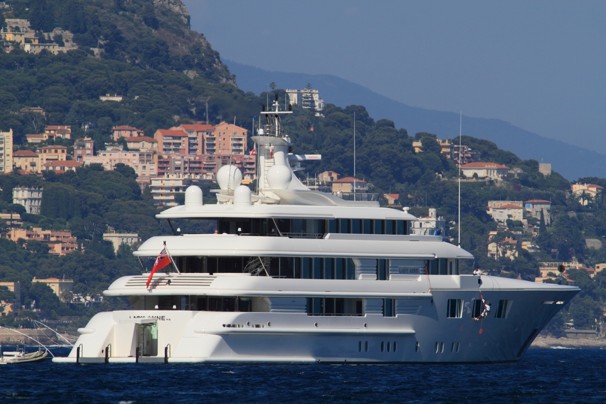
Washington Redskins owner Dan Snyder is now the proud owner of a $70 million 224-foot "super-yacht."
The Washington Post's Reliable Source reports that Snyder's recent purchase, the Lady Anne, is one of the 100 biggest yachts in the world. Snyder bought the yacht with a group of investors for around the same price that he'll spend on two-thirds of his Redskins payroll for the year. (Or, if you want to look at it a different way, the yacht cost $30 million less than it took to secure the rights to Albert Haynesworth(notes) in free agency.)
Snyder's estimated worth is $1.1 billion. The yacht's listing price was $86 million when it went on the market earlier this year, but sold for considerably less. (The Post's $70 million figure was an estimate.) It was custom-made in 2006 by the co-founder of Nine West, Jerome Fisher. Later, Fisher and his wife would lose $150 million with Bernie Madoff.
Burgess, a company that rents out the boat for use on the Mediterranean, boasts of the yacht's grandeur:
From the moment you step on board you are taken back in time to the grace and glamour of the 1920s, with a La Modern French period design throughout. A magnificent spiralling five-storey staircase leads you to the spacious decks, be it the comfort of the main salon, the fabulously appointed theatre room or the light and airy upper salon for a pre-dinner cocktail.
Accommodation comprises of 6 beautifully appointed cabins for up to 12 guests, each with en suite jacuzzi bathrooms. The master suite is designed as a self-contained apartment, with his and her bathrooms featuring rare, pure white triple A-grade Thassos marble, as well as a library and VIP cabin.
Among its many other features:
1. Looks great from March to August, then fails to perform from September to January.
2. Can be replaced every three years by another yacht that will seem much better than the previous yacht, yet will quickly fall out of favor when another, even better, yacht becomes available.
3. Has an on-board courtroom to help pursue frivolous lawsuits at sea.
4. Includes a kid-sized bed so Tom Cruise will have a place to sleep when he visits.
5. The crew of 18 includes a manager named Danny. He cannot be fired for any reason, even if his crew repeatedly spills wine on guests, botches meal service and blocks the back of the boat during smoke breaks.
6. At $8.75, beers are a bargain.
7. Needs to be docked 10 miles away from Washington, D.C., in the middle of nowhere at a nondescript location with not enough parking and too few roads to handle the crush of passengers.
8. Won't be as big as the yacht Jerry Jones inevitably purchases.

Share

Twitter Delicious Facebook Digg Stumbleupon Favorites More